
The so-called single-meter model for PV in multi-family buildings is often seen in practice as a supposedly unbureaucratic shortcut to tenant electricity (Mieterstrom). Upon closer legal examination, however, it turns out to be a dangerous pseudo-solution: It by no means exempts landlords from the energy law obligations of an energy supply company (EVU), violates the statutory right to free choice of supplier, and does not withstand current Federal Court of Justice (BGH) case law on customer installations. Anyone who wants to distribute solar power to tenants in a legally compliant manner and without bureaucratic overhead must rely on solutions that keep the operator free from utility obligations.
Turning rooftop area into a reliable source of income: The supposedly unbureaucratic single-meter model for PV in multi-family buildings often turns out to be a costly trap – physical self-consumption distribution secures long-term returns.
What Is the Single-Meter Model in the First Place?
To circumvent the bureaucratic hurdles of traditional tenant electricity, some consultants recommend a simplified basement solution. The idea sounds enticingly simple:
A single main meter: The grid operator installs only one official meter at the building connection. This measures the entire grid electricity intake of the building and the PV feed-in.
Private sub-meters: Simple, private DIN-rail meters in individual apartments measure the respective electricity consumption of tenants.
Waiving the tenant electricity surcharge: The state subsidy according to § 48a EEG is intentionally waived.
Blended-rate billing: The landlord purchases residual grid electricity for the entire property, offsets it internally with rooftop PV power, and issues tenants an annual blended bill.
What appears to be a pragmatic neighborhood initiative, however, does not bypass the strict regulations of German and European energy law.
The Legal Reality: Why the Model Breaks Down Legally
Those using the single-meter model for PV in multi-family buildings often lull themselves into a false sense of security, assuming they operate outside the regulated energy market. From a legal standpoint, however: As soon as electricity is supplied to third parties (the tenants) for a fee, the building owner automatically becomes an energy supply company (EVU) – with all legal consequences.
1. BGH Ruling on Customer Installations & the Acquiescence Risk
The most common misconception lies in the assumption that the building installation is a regulation-free “customer installation” (Kundenanlage) pursuant to § 3 No. 24a EnWG. The Federal Court of Justice (BGH) has clearly refuted this legal view in line with European Court of Justice (ECJ) case law:
Property size is irrelevant: Spatial extent or the number of apartments does not justify an exemption from grid regulation under European law.
Sales dictate status: If electricity is sold to third parties via a grid structure, that structure serves end-customer supply and is legally considered a regulated distribution grid.
Self-supply as the boundary: An unregulated customer installation only exists if the infrastructure exclusively serves internal use and no electricity is sold to other parties.
⚠️ Beware of BNetzA acquiescence: The administrative practice of the Federal Network Agency (BNetzA) of often not actively prosecuting single residential buildings currently provides no protection of legitimate expectations in civil courts. If a dispute with a tenant or competitor arises, courts rule strictly according to BGH case law. The acquiescence argument then collapses immediately.
2. Systemic Risk: Free Choice of Supplier Pursuant to § 20 EnWG
The single-meter model technically works only as long as 100% of all parties in the building purchase their electricity from the landlord. Legally, however, this cannot be enforced:
Prohibition of tying arrangements: Electricity supply cannot be tied to the tenancy agreement. Every tenant has an unalienable right to free choice of supplier under § 20 EnWG.
The domino effect: If even a single tenant exercises this right and selects an external electricity supplier, the grid operator is obliged to install a dedicated meter for that household. The single-meter model collapses technically, forcing costly, retrospective retrofits in the meter cabinet.
3. EVU Obligations & Tax Utility Status
Those attempting to bypass the obligations of traditional tenant electricity under the single-meter model fall directly under the general requirements for energy suppliers:
Supplier notification: The commencement of electricity supply must be formally reported to the Federal Network Agency.
Consumer protection: The annual invoice must meet strict transparency requirements (disclosure of energy mix, CO₂ emissions, comparative data). A simple item on the utility bill is unlawful.
Electricity tax law: Selling electricity makes the landlord liable for tax with the Main Customs Office. It requires authorization as a supplier as well as annual tax returns.
Unbundling of accounting: Property rental and electricity sales must be kept strictly separate in accounting records.
The Unbureaucratic & Legally Sound Alternative: Hardware-Based Energy Distribution
The fact that the single-meter model for PV in multi-family buildings is legally vulnerable by no means implies that landlords must forgo the returns of a solar system. The solution lies in a shift of technology: Away from utility-style electricity sales as a full supplier – toward hardware-based direct distribution.
PIONIERKRAFT has developed a system that transfers solar power on demand directly into apartments via a physical direct line (§ 3 No. 12 EnWG).
Key Advantages of the PIONIERKRAFT Solution:
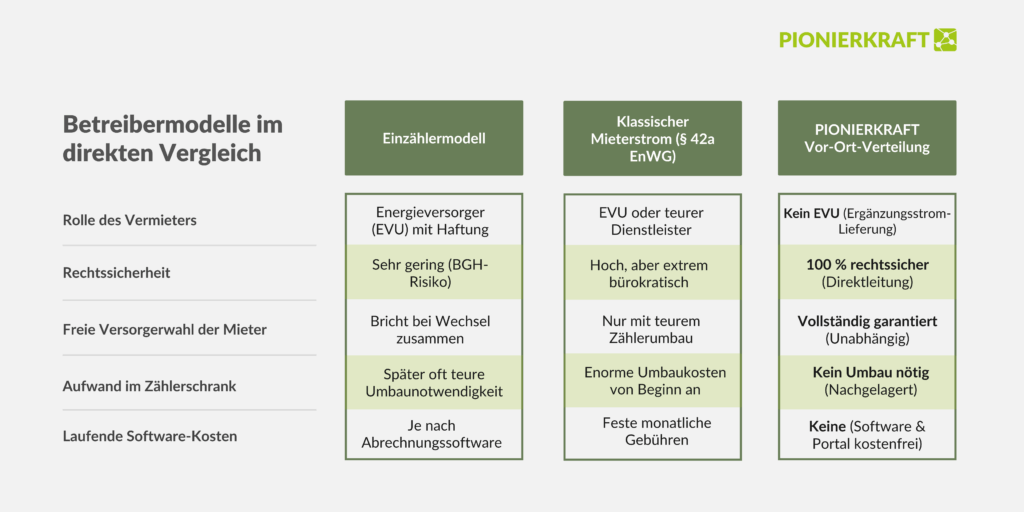
No utility role (No EVU): Landlords do not become energy suppliers. They do not sell residual grid power and do not assume full supply responsibilities. The system physically transfers purely surplus solar power as supplementary energy.
Full freedom of supplier: Every tenant retains their existing grid connection and electricity contract. If a resident switches suppliers, it has zero impact on PV distribution.
No meter cabinet refurbishment: The hardware is connected downstream of the existing meter cabinet. Expensive total overhauls or coordination regarding metering concepts are eliminated.
No ongoing software costs: While the wall-mounted hardware physically distributes electricity, the PIONIERKRAFT portal automatically provides billing data – completely free of monthly subscription fees.
💡 How such a project is economically implemented in practice in a rental property is demonstrated by a landlord of a 6-unit residential building in this field report.
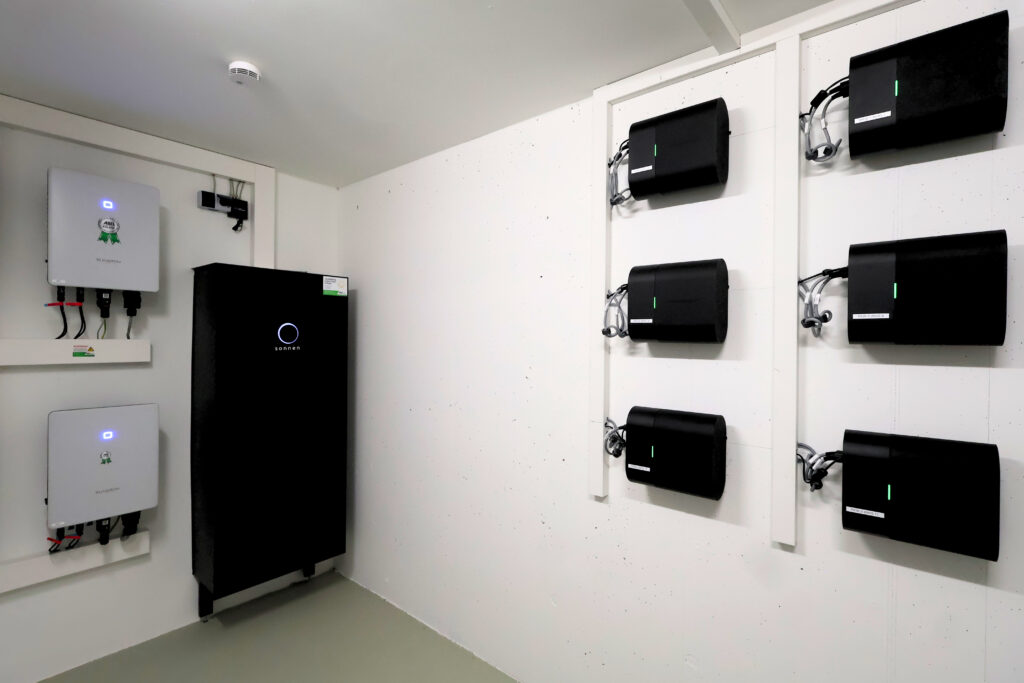
Direct line instead of a bureaucratic trap: Hardware-based self-consumption distribution physically routes solar power through the private building network without turning property owners into regulated energy suppliers.
Direct Comparison of Operating Models
Do Not Be Fooled by Pseudo-Solutions
The single-meter model for PV in multi-family buildings is often touted as an easy way out. However, legal reality demonstrates: It ignores statutory requirements for energy suppliers and offers no legal protection following recent BGH rulings. For property owners, it carries substantial liability risks due to back-taxes, regulatory interventions, or costly retrofit requirements.
Anyone wishing to utilize solar power in multi-family buildings economically, legally, and unbureaucratically should not rely on legal gray areas. With hardware-based, on-site distribution, you share electricity directly, protect yourself from utility obligations, and drive the decentralized energy transition without high administrative burdens.
📈 Would you like to know how much return legally compliant self-consumption distribution can generate for your specific property? Use free PIONIERKRAFT profitability calculator and determine your yield potential in just a few steps.